
Editor’s note: Spencer Klinefelter is the Program Coordinator for the Central Coast Prescribed Burn Association in California, covering Santa Cruz, Monterey, and San Benito counties, and a California Certified Burn Boss. He has worked with good fire across the American south and much of California, and appreciates a good night burn when conditions align. In this blog, Spencer recaps the Forester TREX – a training exchange specifically tailored for foresters looking to apply more fire as a forest management tool.
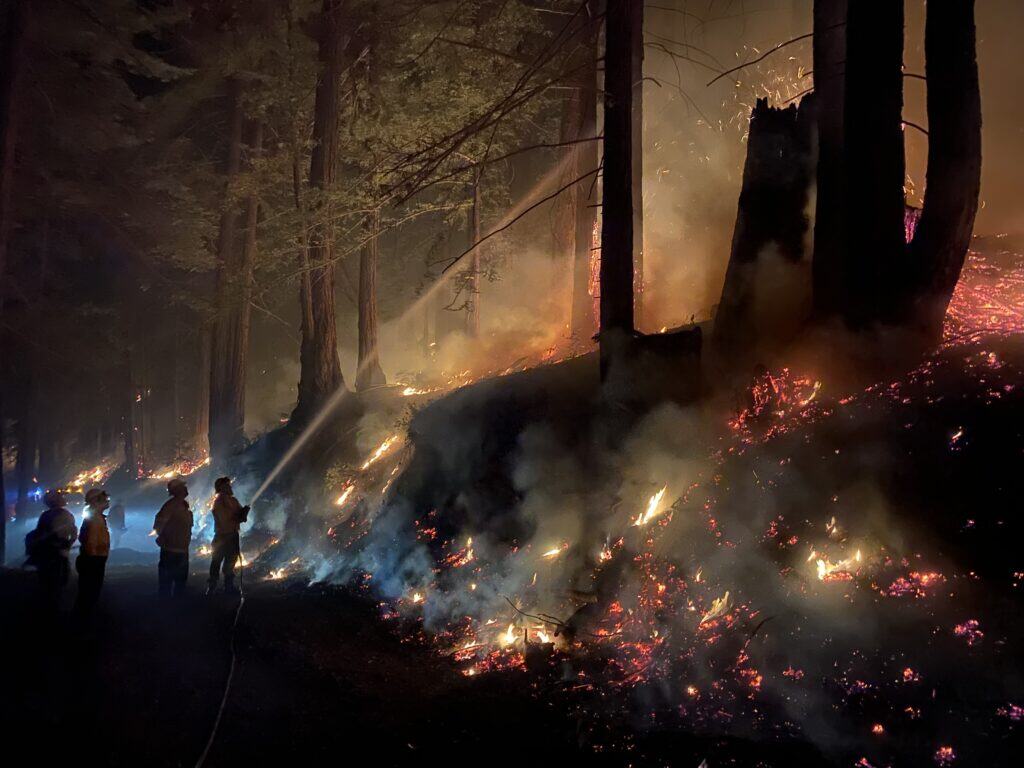
The temperatures had finally dropped, the winds had settled down, and the humidity was just creeping into prescription. The good news? It was only getting cooler, and more humid as the night wore on. Around 7pm, with the fading late still slanting through the trees, the first torch was tipped and a ring of fire drawn around the trunk of a redwood tree. The burn was underway…
New Applications for the TREX Model
The TREX model has been around for well over fifteen years now, bringing people together over the course of a week or so to learn, burn and share in the experience of stewardship. In California alone, there are more than a dozen TREXs a year scattered across the state; their success at engaging people, and getting good fire on the ground, is undeniable. This success led Jared Childress, Program Manager of California’s Central Coast Prescribed Burn Association (CCPBA), in conversation with The Lookout’s Zeke Lunder, to consider two questions:
● Who else might benefit from the TREX model?
● How can we leverage this idea to reach land managers and decision-makers who aren’t focused purely on fire?
The Forester TREX is Born
One answer to these questions is registered professional foresters (RPFs). Responsible for much of the land management across the four million or so acres of working forests in California, plus tens of thousands of acres held or managed by land trusts and conservation organizations, RPFs represent an obvious choice when it comes to connecting people with prescribed fire as a management tool.
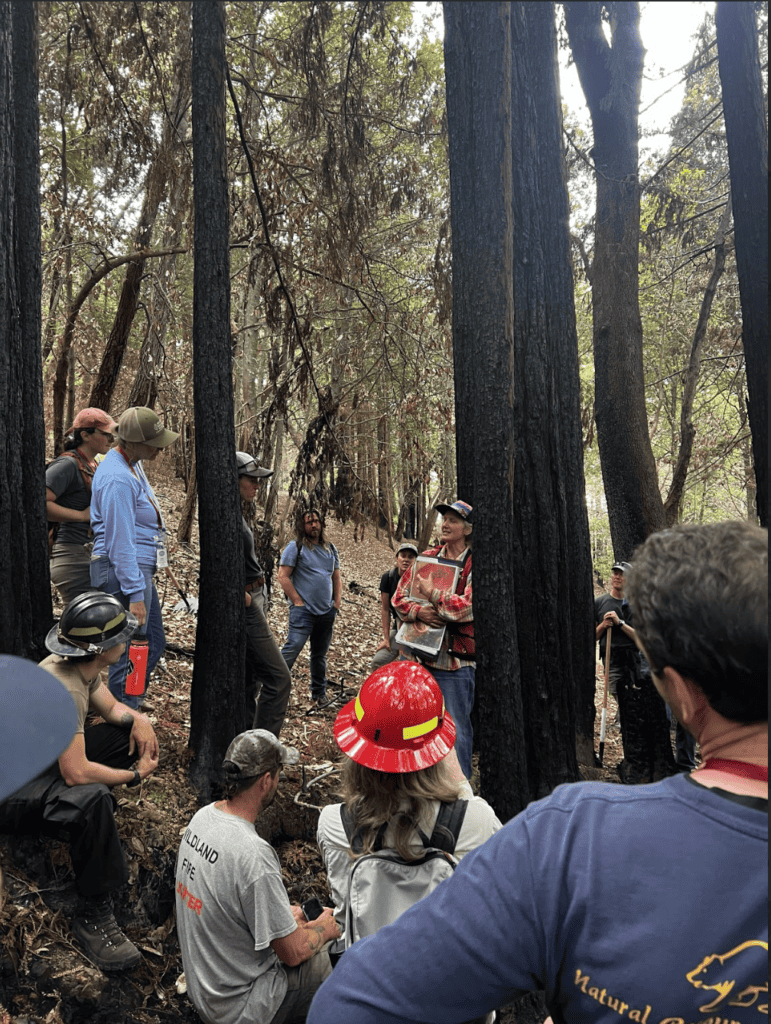
The CCPBA had funding from the State Coastal Conservancy to organize two TREX events, and hosted the first Forester TREX (FTREX) in early June of 2024 in Santa Cruz County. Focused mostly on Coast Redwood, the event brought together over 40 participants from across the state; not just RPFs but also staff from State Parks, regional County Parks, various land trusts, policy makers, and academics focused on forestry. Over four days, participants engaged in presentations and conversations around the intersections of fire and forestry, and some of the many complexities of planning and operationalizing prescribed fire in Coast Redwood stands while also balancing timber yields and economic viability.
The FTREX included one burn over those four days, which ended up occurring at night due to dry, windy conditions during the day of the scheduled burn (one of the challenges of TREX events is scheduling them so far ahead of time, hoping you end up with good weather windows and burning conditions). The burn, a fairly small 6-acre unit of redwoods up near a ridgetop, allowed those new to prescribed fire to see it and feel it for themselves – the heat and glow of flames backing down a slope, of course, but also the joy and sense of community that often comes from burning.
Perhaps the biggest distinction between normal TREXs and the FTREX is how deep into the weeds participants wanted to go – discussions on the nuances of defect and rot introduced into timber from higher intensity fires and their effects on merchantability, conversations around policy and permitting and different overlapping treatments, presentations on liability; this TREX was focused not truly on burning, as most are, but on building stronger relationships between forest managers and the culture of good fire, and emphasizing that fire has a place even in working forests.
FTREX 2.0 – From the Coast to the Mountains
After the success of the first FTREX, consideration was given to where else in the state would make sense for such an event. The emphasis on Coast Redwood in the first one attracted a lot of coastal foresters, but there is plenty of interest and timberland elsewhere in the state, particularly in the Sierra Nevada, and therefore plenty of RPFs who could benefit from an FTREX focused on the Sierra mixed-conifer forest.
Blodgett Forest Research Station is a UC Berkeley-managed working forest that is used for research and teaching, and has a long history of using and studying low-severity fire as a management tool. Rob York and Ariel Roughton, Director and Station Manager respectively, provided extensive support for the TREX and allowed the group to explore “pyrosilviculture” in combination with other more traditional forestry methods such as thinning and mastication, all of which have long histories at the site. Their expertise the land use history made Blodgett an obvious choice, and in late October 2025 the second FTREX occurred there over the course of a week.
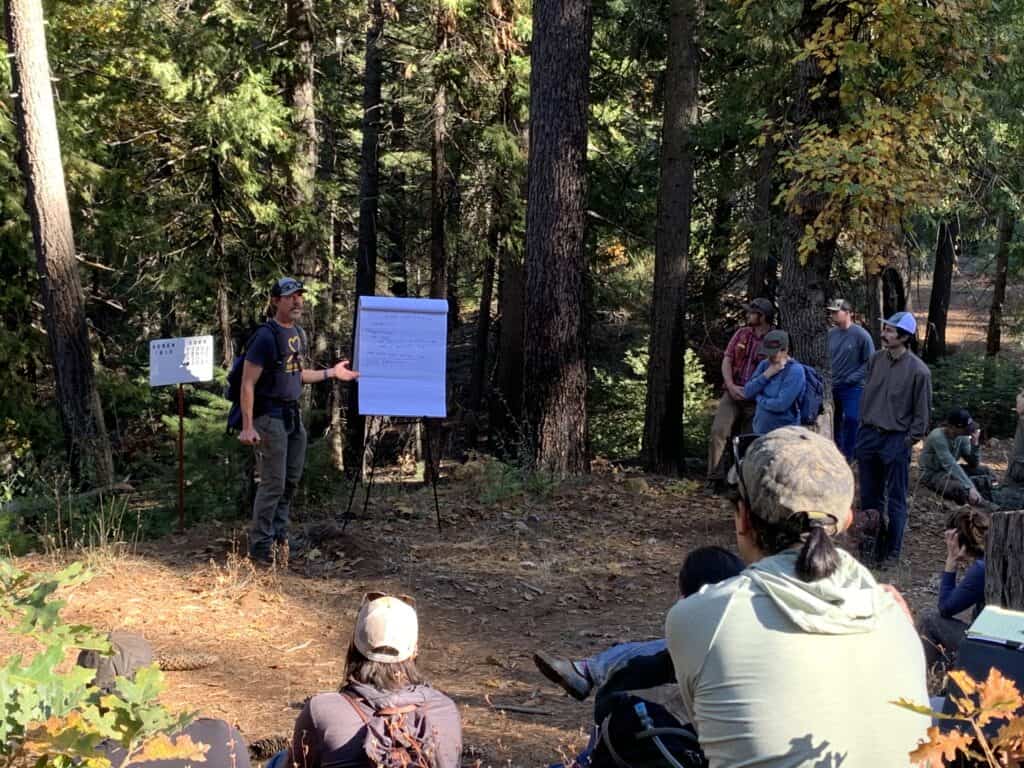
The second FTREX dove deep into research focusing on different treatment combinations and their effects on timber, part of the national Fire and Fire Surrogate Study (a write-up on this research can be found here). Days included field tours at Blodgett, discussions and presentations on the effects of fire on timber, a day of pile burning, and one broadcast burn on nearby private timberland supporting the local El Dorado Amador PBA.
On the final day of the TREX, Halloween, participants gathered to review and discuss some of the many details to consider when burning: weather conditions, firing patterns, how to delineate burn units, and the process of remaining open to learning from experience. The afternoon concluded with small, mellow patch burning on Blodgett property and local tribal participants sharing some of their history and stories, smoke drifting up beneath black oaks and ponderosa pines.

The Forester TREX: A Smaller Target Can Lead to a Bigger Impact
The Forester TREX events have only occurred in the past two years – their full impact remains to be seen. But the idea is a sound one: gather people together whose job it is to manage and think about landscape-level stewardship in order to share ideas and experiences around the use of prescribed fire. The success of these two FTREX events comes not from acres burned, but via the more nebulous idea of building a culture that supports and embraces fire as a tool for ecological health, economic viability, and social connectedness. Focusing on foresters and creating a TREX centered on sharing best practices at the intersection of fire and forestry allowed participants to go deeper on the topics that interested them, and their day to day planning and work.
These aren’t individuals who will likely go on to build their careers around fire, but they may go on to incorporate it more fully into the work they already do, and move the needle that much more on normalizing fire, and smoke, on the landscape. And that is the real goal: to one day step outside, smell smoke in the air, and instead of feeling fear, think someone is doing good work somewhere around here.
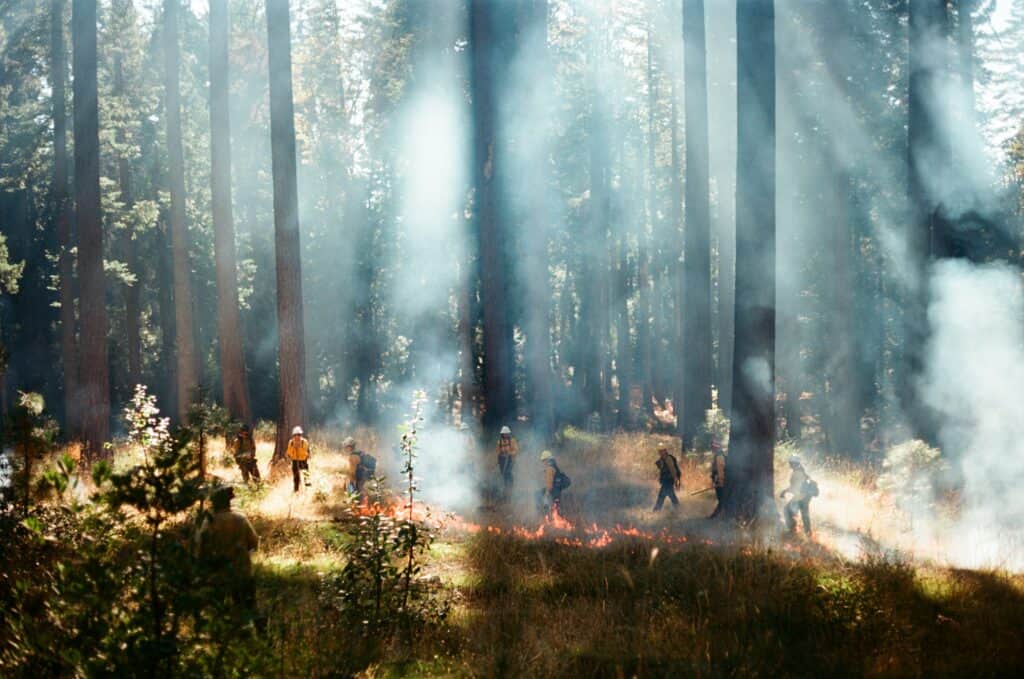
Forest Research Station. Photo credit: Spencer Klinefelter.
Some questions and final thoughts to leave you with:
● Are there other themed TREX events that might make sense in your region or community?
● During training events and workshops, how can you engage key individuals who hold outsized influence on land management in the area?
● During TREX events, leave time for discussion and exploration of the ideas that participants bring with them. Work on the ground, and work in community.
****